Posts

Showing posts with the label Book review

The trade-off between equality and efficiency reexamined

Image
After having read and reviewed Stiglitz's book  earlier this week , and after having written the following paragraph... "I too have long considered the relationship between equality and efficiency to be non-linear, instead of just a simple trade-off. Too much equality isn’t good since it reduces incentives, but neither is too much inequality. I would say the relationship is of an inverted-U type where moving to both extremes – too much and too little equality is bad for the economy. The trick is to find an optimal point which reduces the level of inequality where it offers more opportunities for everyone, but also just enough for it to continue to drive incentives. More on that in my next blog post." ...I just had to dig deeper into the whole equality-efficiency trade-off . So I picked up a seminal book from a man who specialized in economic trade-offs, none other than -  Arthur Okun ! Okun is more famous for his "law" stipulating the linear relationsh...

What I've been reading (vol. 11): Atkinson & Stiglitz

Image
Atkinson, Anthony (2015) Inequality. What Can Be Done? Harvard University Press & Atkinson, Anthony (2008) The Changing Distribution of Earnings in OECD Countries. Oxford University Press The first two books, both written by the same author, Oxford economics professor Sir Tony Atkinson , will be reviewed jointly. The reason is that the earlier book, The Changing Distribution of Earnings in OECD Countries is more a case study summary of the empirical facts behind the rise of inequality in the West in the past century, the point of which is again summarized in the first few chapters of the author’s latest book Inequality . Basically the earlier book is a very detailed portrayal of the worrying inequality trend in the case of 20 OECD economies. It has two main parts – the first which depicts both the theoretical arguments and the summary of the historical trends for all the given countries, and the second which (on over 200 pages) details all the data, the graphs and the ind...

What I've been reading (vol 10.): Cronyism and inequality

Image
Zingales, Luigi (2012) A Capitalism for the People. Recapturing the Lost Genius of American Prosperity. Basic Books, New York. Luigi Zingales , a University of  Chicago Booth School of Business professor of finance, is one of the true champions of liberal, free market ideas. In this book, similar to his previous success “Saving Capitalism from the Capitalists” (co-authored with Raghu Rajan), he delivers a powerful case in favor of markets, competition, liberty, and against big business, big governments and their clientelistic (cronyist) mutually beneficial relationship. In other words, Zingales knows the crucial and very important distinction between being pro-business and being pro-market . Confusing one with the other is a typical mistake every advocate of socialism tends to make – they tend to blame capitalism, markets, and the ideology “neoliberalism” for close ties between politicians, big businesses, and the media. Zingales correctly points out that this is hardly the cas...

What I've been reading (vol 9.) Economic history: Malthus and beyond

Image
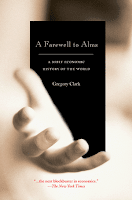
After the very intriguing part 1 covering two fascinating books whose contribution extends across a few scientific fields, this one lays out two books with a more contemporary historical emphasis.  Clark, Gregory (2011) A Farewell to Alms: A Brief Economic History of the World. Princeton University Press Clark’s book is first and foremost a wonderful economic history textbook. Although it carries in its title the word “brief” it represents quite a comprehensive overview of the patterns before, during and after the Industrial Revolution that can be accredited with having created the modern world. It is a good book, full of empirical data and a very detailed overview of the facts behind the patterns responsible for modern development. It is thus more a scientific work that a popular one (closer to Diamond’s Guns, Germs, and Steel, than Harari’s Sapiens). The book is separated into three parts, each important in painting the picture of why and how the Industrial Revoluti...

What I've been reading (vol 8.): Economic history

Image
As announced in the previous blog post the next two book reviews will cover four very interesting history books (well, history to some extent). The first one is actually all about geography and anthropology, and little bit about history - the Pulitzer winning book by Jared Diamond: Guns, Germs, and Steel . It has long been on my reading list and I am finally happy to have read it, and I have to say - it hasn't disappointed. Far from it actually. I can see why it was an instant success. The second is a more recent book, Harari's Sapiens . Another bestseller with an overreaching arc that extends from the biological knowledge about our ancestors all the way to the modern technological revolution that has the power to destroy our very species. In short, two brilliant books! Let's begin.  Diamond, Jared (1997) Guns, Germs & Steel: The Fates of Human Societies . Norton, New York. In this Pulitzer Prize-winning book, Jared Diamond, a noted polymath (made contributions ...