Posts

Showing posts with the label CA deficit

Reinhart and Rogoff on the crisis and the recovery

Image
Carmen Reinhart and Kenneth Rogoff, Harvard professors and the authors of the brilliant " This Time is Different ", did an interview for Barron's  last week on the causes of the crisis and the slow recovery from it. (In a post from  November  last year I summarized some of their main points.) Read the whole interview, it's very interesting. In a majority of their arguments I agree with them, some of them I have used repeatedly on the blog. For example:  "No two crises are identical. Policies differ, and political systems differ. But the common thread is this sustained buildup in a period of really bold optimism, often predicated on the expectation that if asset prices have gone up today, they are going to go up tomorrow and, therefore, we can borrow fairly indiscriminately without a problem. What was also very illuminating was that the U.S. wasn't alone. You saw Ireland, Spain, Portugal, Greece, and the U.K. with a very similar pattern of debt b...

“Why a collapse of the Eurozone must be avoided”

Image
A Swedish economist Anders Aslund (senior fellow at the Peterson Institute in Washington) wrote an excellent article a few weeks ago on why a collapse of the Eurozone must be avoided under all costs. I recommend you read the whole thing .  His point is partially based on a historical comparison of what happened with the break-up of three previous multi-nation currency zones, namely the ones of the Austro-Hungarian Empire, Soviet Union, and Yugoslavia. The structure of these economies differed to a great extent to the structure of the EU today, but some lessons can certainly be applicable. His view is, and I agree, that too many economists think of a euro break-up as a mere devaluation that would benefit the exiting states. But not too many recognize the possible dire consequences this could bring to exiting countries (mostly everyone is preoccupied with what the effects will be on countries that remain in the Eurozone, or provided there is a full break-up , what will th...

What’s behind Iceland’s rapid recovery?

Image
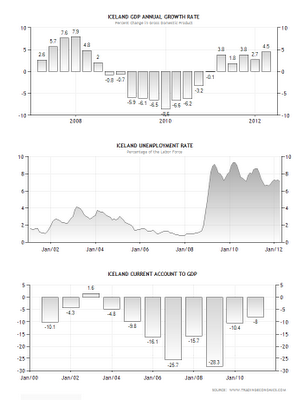
Source: Trading Economics Iceland’s crisis and recession went down much harder than in most European countries (well, except Greece ). Cheep credit and (unobserved) accumulation of systemic risk in the early 2000s led to a substantial distortion of signals sent to the real economy. They had a huge exposure to the US financial system with assets tied to many US subprime mortgage-based securities . The post-Lehman collapse followed by the subsequent bankruptcy of Iceland’s overleveraged banks was hardly a surprise. The state interfered by protecting domestic depositors, not allowing the taxpayers to take the burden of a bailout. But this didn't stop Iceland from leading  a first case of a trial against a PM for mishandling of the crisis (accused for "negligence"). Mr Haarde was later found innocent by the countries’ courts, but it was nonetheless a strong message sent from Iceland on the seriousness of what happened back in those years. The GDP fell during his prime-m...

Russia’s path to a twin deficit

Image
Vladimir Putin , still hailed by many in Russia for their successful transition from socialism to ‘state capitalism’, is facing much more economic instability than he did in his first two terms (from 2000 to 2008).  To remind the readers, the Russian transition from socialism in the 90-ies was characterized by a booming number of oligarchs who controlled most of Russia’s oil and gas resources and which were to a large extent responsible for increasing criminalization and impoverishment of the country. In such a desperate situation which has seen Russia slipping from the world super-power to a bankrupt economy dependent on Western aid, the people longed for a leader who can set the country straight again. After all, one has to bear in mind that the Russians got used to having dominant leaders in the past, even much before the Bolshevik revolution in 1917. Never has Russia experienced true political freedom and democracy (especially not in the oligarch-controlled 90-ies), so the...

Graph of the week: Eurozone dependency

Image
This week's graph comes from the Economist as another verification of my earlier ideas on the causes of eurozone contagion . Here's what it says: " Borrowing too much from foreigners can imperil your nation's health LOTS of countries in the rich world ran pro-cyclical current-account deficits before the financial crisis hit, which is to say they borrowed heavily when times were good. Yet only a handful have seen yields on their sovereign debt spike to alarming levels. One reason for this, as the chart below shows, may be an over-reliance on fickle foreigners to finance those deficits. Italy, which has a high rate of domestic savings (and thus is less reliant on finance from abroad) and yet also suffers from high yields on its debt, is an outlier." ( Daily chart , The Economist, 13th April 2012 ) I would add that the key reason why foreigners financed the CA deficit is linked to the common currency and the banking regulations which led to a  leve...

Imported instability: examining the causes of eurozone contagion

Image
Note: this article is an update and summary of the sovereign eurozone debt crisis page . I've added a few things and broadened the analysis. In light of the expansionary austerity debate in peripheral Eurozone, the conventional solution surrounding Eurozone’s recovery has been a call for fiscal adjustment. The idea supporting austerity arises from the viewpoint of recklessness of peripheral Eurozone governments and their extensive debt accumulation and crippling welfare states. Even though a certain level of fiscal profligacy and strong accumulation of debt were apparent in peripheral Eurozone (and it is certainly the main issue holding back its recovery), this was hardly the most important reason behind a strong and severe recession that struck these countries. The focus of the article will be on the spread of financial contagion onto the peripheral Eurozone economies, namely Greece, Portugal, Ireland, Italy and Spain.  The problems that occurred for the peripheral Eurozon...

Eurozone crisis – analysis of causes and consequences (part 2)

Image
The second part observes problems inflicted to the eurozone economies from abroad. It then looks at how foreign capital inflows (due to large CA deficits shown in part 1 ) were used in domestic economies.  (Regarding the current affairs, the economist offers its own short history of the eurozone crisis , worth reading. In addition, its Free Exchange blog offers two good texts on the current eurozone affairs, one on Spain , the other on Italy .  Tyler Cowen offers an interesting summary on what we learned from the euro crisis on his blog Marginal Revolution.) Instabilities from abroad Problems with a CA deficit and the common currency When one country runs a current account deficit, this implies that it runs a surplus in its capital account. A capital account surplus means an inflow of foreign capital (investments) into a country, which is essentially a good thing since money will always flow to where it expects the highest and safest returns. However, the question i...

Eurozone crisis – analysis of causes and consequences (part 1)

Image
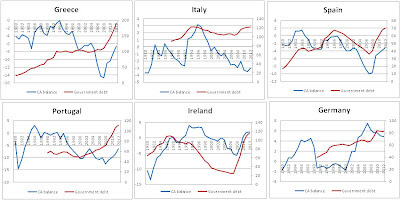
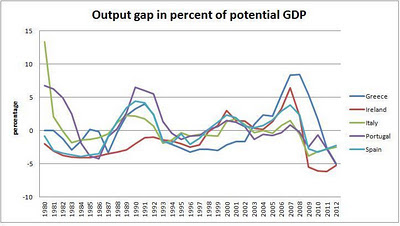
In the next few days I will publish a series of blog posts about the causes and consequences of the eurozone crisis. I will cover the potential reasons why the peripheral eurozone economies suffered a particularly hard hit. The political responses and potential remedies to the eurozone crisis have been published in two previous posts . After publishing all the blog posts, I intend to make a separate page on the eurozone crisis. The topic itself will probably continue for some time as the situation around eurozone currently carries the highest risk for another recession, and so will the page on the crisis be updated.  Causes of the eurozone contagion The focus of the first few blog posts will be on the spread of financial contagion onto the peripheral eurozone economies, which include Greece, Portugal, Ireland, Italy and Spain. The reasons why these countries in particular found themselves in such troubles can be separated into three features which they all share. The first are s...