Posts

Showing posts with the label Confidence

The corporate debt bubble: CLOs and company bankruptcies
Image
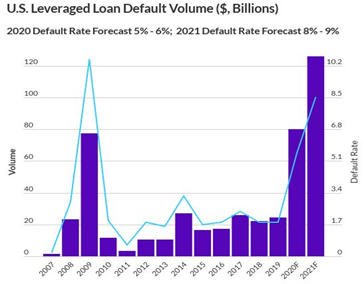
In addition to monetary and fiscal bubbles , another potential issue that could be exacerbated by a prolonged period of low interest rates are rising corporate debt levels of publicly listed nonfinancial companies. Total corporate debt of such companies has already reached historical highs by surpassing $10 trillion in Q1 2020 , and is likely to keep growing in the months to come. Adding to this another 5.5 trillion of corporate debt from SMEs and other non-listed companies the total corporate debt size in the US is now at 73% of GDP . This is still lower than household debt in 2009 which reached almost 100% of GDP, and with lower rates of growth. However, corporate debt will keep on rising – as it did during the 2009 crisis – as a necessary consequence of the pandemic and increasing risk exposure of many companies. Leveraged loan market and CLOs About $1.4 trillion of that market (also at historical highs) is comprised of leveraged loans , which include all loans securitized in someth...

Explaining our current stagnation

Image
Ever since the financial crisis of 2007-2009 and its subsequent (slow and modest) recovery  many have claimed the world has entered into a state of prolonged stagnation. In addition to economic growth being relatively low (and therefore not enough to close the potential GDP gap caused by the crisis), real wages are also stagnating, unemployment is still high (although in relative decline), inflation is close to zero, while productivity growth is sending troublesome signals for some time now. This is particularly true of Europe, as it bears the strongest resemblance to Japan , and is on a good course to repeat Japan's (still ongoing) two decades of stagnation (more on emulating Japan in my next text).  We all know the story. I, for one, have told it many times on the blog (see here ,  here , here , here , here , here or here ). After the financial crisis, which usually tends to cause prolonged and slow recoveries, many governments adopted stimulus and bailout program...

BREXIT, THE REACTION: democratic deficit, the falling elites, and the future of the EU

Image
After hearing the results of the Brexit referendum on early Friday morning, my initial reaction was this comment on Facebook: After cooling down over the next few days and reading about Brexit from a number of perspectives, I have to say that everything I said initially - still holds. I will carefully explain each point. First, the democratic deficit problem . This is, sort of, my PhD topic, meaning that I'll be writing quite a lot about it over the next few years. Before explaining why this outcome is a deficit of democracy we must first define the concept of democratic deficit (or perhaps even - democracy failure ). Basically, the democratic deficit concept concerns the interaction between politicians and partial interest groups, a legitimate consequence of electoral competition and political freedom to express and fight for one’s interests, and whether or not this interaction results in adverse economic outcomes (in my PhD I will be focusing on linking the failures of ...

The Swiss are encouraged to DELAY paying their taxes!?

Image
Last week the FT brought the story that a certain Swiss canton, Zug , is asking its taxpayers to delay paying their taxes and their bills. Surely to anyone this piece of news sounds astonishing. The authorities are asking their taxpayers not to pay their taxes on time? What an atrocity! What is to make of this?  First a few words on the specifics of the Swiss tax system. The authorities of the canton are simply asking their taxpayers not to pay their taxes early . A policy of the Zug canton has been to reward early payments of tax bills by giving discounts to those who do. This means that a taxpayer can lower its tax bill by paying early. It is a great encouragement for both the authorities to maximize their fiscal capacity and tax collection, and for the taxpayers to pay their taxes (the alternative of not paying - tax evasion - carries a greater opportunity cost once you are given an incentive to lower your tax bill. The policies of tax amnesty are similar in its incentiv...

Graph(s) of the week: Companies' cash holdings

Image
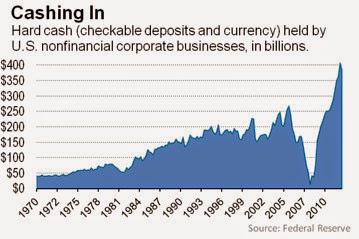
According to numerous reports, it seems that the biggest world companies are sitting on record levels of cash holdings. If this is true, the question is why aren't they spending it? According to Financial Times , in 2008 the biggest 1000 world companies held a total of $1.95tn in cash, however by the end of 2012 this level has jumped up to $3.2tn. This can be attributed solely to the credit slump and the consequential severe lack of confidence during the entire recovery period.  However in 2013 the cash reserves kept on rising despite a rebound in the stock market and rising business confidence with still very low interest rates. All this should have encouraged more spending and investing from the business side, but cash reserves just kept on rising.  Source: WSJ and US Federal Reserve  Source: The Telegraph However, it is obvious the distribution of these funds are uneven. The very fact that only the top companies are holding all this cash is bi...

Prognosis: Negative - or How close were my predictions for 2013?

Image
Last year, a few days before the year ended I embarked in a bold quest of making predictions on economic and political outcomes in the year to come, facing the risk of making a fool of myself by completely misfiring. Luckily, I was actually rather close in most of the predictions made. Before I start evaluating my performance, I would just like to make a quick digression on the precision of forecasting. Why do we make predictions? Because we're facing an uncertain future. Our decisions today depend on the expectations of what the future will bring and how our decisions will be affected by it.  So how can we be sure that a forecast will actually turn out to be correct? We cannot. We can evaluate someone's past performance in predicting things like real economic variables or political outcomes and based on this alone determine how good he or she is in making a correct prediction. But in general we can never be certain. I read somewhere of an experiment done back in the 8...

Loss of hope in Europe (or not quite?)

Image
From FT Alphaville , using Pew's surveys, concluding on how there is a steady decline in support for the European project, particularly among the youth:  "Support for European economic integration – the 1957 raison d’etre for creating the European Economic Community, the European Union’s predecessor – is down over last year in five of the eight European Union countries surveyed by the Pew Research Center in 2013. Positive views of the European Union are at or near their low point in most EU nations, even among the young, the hope for the EU’s future. The favorability of the EU has fallen from a median of 60% in 2012 to 45% in 2013. And only in Germany does at least half the public back giving more power to Brussels to deal with the current economic crisis." The economic conditions are particularly bad across the continent; South Europe is in deep moral and economic distress, the French are loosing hope in their newly elected President and for the first time f...

The reverse savings glut

Image
The personal savings rate in the US has experienced a steady decline in the past 30 years, up until the recent crisis: Source: FRED From the Economist : "The drop began in the 1980s, perhaps because the Great Moderation made people less fearful of economic uncertainty. When uncertainty returned during the financial crisis, and as credit conditions tightened, the saving rate shot up. Wage stagnation may also play a role; people expected better living standards and cut back on saving to raise consumption. The saving rate fell again this past January. That may reflect greater economic optimism or the return of the full payroll tax, which lowered take-home pay. Rather than decrease consumption people may have saved less." A declining savings rate is a worrying signal to the economy as it increases its vulnerability to crises. The reasoning is clear; the higher the leverage of the private sector in pre-crisis times, the stronger the deleveraging will be after the shock. P...