Posts

Showing posts with the label Budget

Week links (5)

Image
After a short break, the week links are back. 1. Cowen: "Modeling Vladimir Putin" , Marginal Revolution blog - of all the texts analyzing Putin's reaction of the Crimea situation , I find this one to be the most interesting. "Putin lives in a world where power is so much the calculus — instrumentally, emotionally and otherwise — that traditional means-ends relationships are not easy to define. Power very often is the exercise of means for their own sake and means and ends thus meld and merge. Our rational choice constructs may mislead us and cause us to see pointless irrationality when in fact power is being consumed as both means and end. It is hard for we peons to grasp the emotional resonance that power has for Putin and for some of his Russian cronies. They grew up in the KGB, watched their world collapse, tyrannized to rise to top power, while we sit on pillows and watch ESPN." 2. Last week was budget week in the UK . Osborne delivered a new budge...

Graph(s) of the week: best from the 2013 Budget

Image
Even though the focal point of attention this week was Cyprus, in Britain the central issue was the 2013 Budget , for which I found some policies encouraging but some of them deeply disappointing  implying that there Osborne still hasn't got a clue as to how to initiate the recovery.  Anyway, from the Budget and the OBR report I found a couple of interesting graphs, some good, some bad. I start off with tax competitiveness and how the UK has significantly increased its competitiveness vis-a-vis the corporate tax rate cuts on KPMG's survey (the survey is based on businesses responding to the changes):  Even in comparison the 20% announced corporate tax rate (in 2015) is beginning to look very good: On this list, among the lower rates, the UK has by far the strongest institutional system and rule of law, thereby triggering positive signals to attract new investments. It's unfortunate for the US and Japan not to follow upon ...

UK Budget 2013: the analysis

Image
Similar to what I did last year , this year I will once again analyze the new UK budget announced yesterday by the (downgraded) Chancellor George Osborne.  The initial reaction is actually better than last year, except for some policies which haven't changed and some new woeful ideas. You can read summaries of the budget from a variety of sources: Financial Times , BBC , Telegraph , Guardian , CityAM , think tanks ( ASI , IEA , CPS ) or watch this interesting video from the FT: Before we move on the budget itself, the UK Office for Budget Responsibility  issued their revised growth forecasts, and things still look rather gloom for the UK. Growth was revised to 0.6% this year and 1.8% in 2014. (Last year the prediction was 0.8% in 2012 and 2% in 2013 - so take the prediction for the recovery in 2014 with slight suspicion, as it always is with growth forecasts). Employment figures still seem to be increasing (even above forecasts), and with stagnating GDP this...

The day after

Image
The fiscal cliff has been averted , for now. It appears that the commitment device I was referring to in the previous text was strong enough after all. My argument was that the Nash equilibrium of the bargaining game will prevent an outcome and force the US down the cliff. I modeled it as a weak commitment device, without time discounting, and without having written down any of the parties' utility functions. Having included these parameters, the game would have given a scope for a cooperative equilibrium, however with a lower probability than a non-cooperative equilibrium. This can be extended in a lot of ways.  Anyway, I wasn't all that wrong, since the budget cuts deal was put off for two months (so no deal was reached here - the model didn't account for extending the deadline), there were no reforms to entitlement spending and there were no reforms of the complex tax code. The tax rate deal was reached , taxing only individuals earning more than $400,000 p/y (at...

Explaining the US "fiscal cliff"

From the Economist comes a good video on what is the fiscal cliff all about: The Wall Street Journal offered their own interactive feature called "Make your own deficit-reduction plan" . So I did. Feel free to check it out here . Please be aware that I was being politically careful when I was making this "plan". On the tax side I extended the Bush tax cuts for middle income families, and focused mostly on easing out tax deductions (here is where I agree with the Economist in pointing out to eliminate tax breaks rather than increasing the tax rates - recall an earlier text on taxes ). I've also found this part interesting: "Tax greenhouse-gas emissions by setting up a program to force polluters to buy a permit for each ton of carbon dioxide emitted into the atmosphere" . Sounds like a good Coase solution to an externalities problem, particularly if these permits could be bought and sold on the market. This, I feel, is one of the best possib...

On budget plans

Image
I already covered the Ryan budget proposal back in March , calling it hypocritical and in certain parts unrealistic. I praised some aspects of his taxation reform proposals, but I didn’t approve of his expenditure side reforms, particularly concerning defence spending, and have fully aligned with what Ron Paul had to say on the Ryan budget, calling it disappointing in which it continues to assume that “the federal government should [more or less] continue to do everything it is currently doing”, and that Congress should learn to “stop trying to run the world, run the economy and run our lives”. Five months later the Ryan budget is again the focal point of attention due to Paul Ryan's nomination for Vice President by Mitt Romney, the Republican challenger to President Obama in the 2012 US Presidential elections. This resulted in many economists and political commentators having once again repeated their main points from five months ago on what this budget can and cannot do. And s...

Russia’s path to a twin deficit

Image
Vladimir Putin , still hailed by many in Russia for their successful transition from socialism to ‘state capitalism’, is facing much more economic instability than he did in his first two terms (from 2000 to 2008).  To remind the readers, the Russian transition from socialism in the 90-ies was characterized by a booming number of oligarchs who controlled most of Russia’s oil and gas resources and which were to a large extent responsible for increasing criminalization and impoverishment of the country. In such a desperate situation which has seen Russia slipping from the world super-power to a bankrupt economy dependent on Western aid, the people longed for a leader who can set the country straight again. After all, one has to bear in mind that the Russians got used to having dominant leaders in the past, even much before the Bolshevik revolution in 1917. Never has Russia experienced true political freedom and democracy (especially not in the oligarch-controlled 90-ies), so the...

Good hunches

As opposed to Samuelson’s faulty predictions of the Soviet Union overcoming the US in the late 1990s, another economist with a popular introductory economics textbook provides much better and more precise predictions. I recently read an article by Greg Mankiw from 2006 , written as a prelude to Paulson replacing Snow as the US Treasury Secretary. Mankiw issues a lot of warnings on the sustainability of the US budget back then.  He emphasizes the importance of consolidating the public finances in the long run as a key challenge for Paulson. Even in 2006, where everything was going so well, it was obvious to Mankiw (and many others) that the demographic pressure was placing a huge challenge on the Social Security, Medicare and Medicaid systems. But somehow there was no credible pledge on either sides of the political spectrum to address this concern. This is the problem with short-termist politicians: if things are going good, don’t try to implement potentially painfu...

The US budget focus

Image
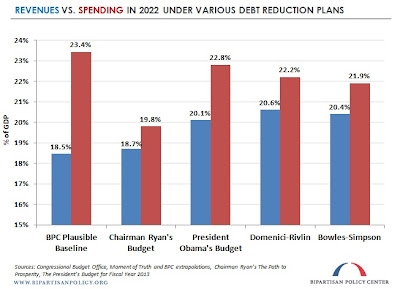
I got hooked up looking at budgets this past week, so now I'll divert my attention to the American budget, or at least a proposal for the American budget.  Since I didn't go into analyzing the Obama budget as I did with the UK Budget (even though I did refer to it in one post on the US debt and deficit where I call on the Bowles-Simpson report), I decided to give some attention to the Paul Ryan Budget proposal (the Republican chair of the House Budget Committee in Congress). I'll try to draw comparisons with the Obama budget to see which one of these is a pro-growth and pro-reform, if any. Note: Next year, I'll make sure to give the US budget the equal amount of attention as I gave to the UK one. Also, I'm removing the 'Red book' from the blog and posting it as a link to the post on the budget . One one side there is President  Obama's budget focused on higher taxes (on the rich to lower inequality), higher spending (on entitlements to keep ...

Graph(s) of the week: Budget numbers

Image
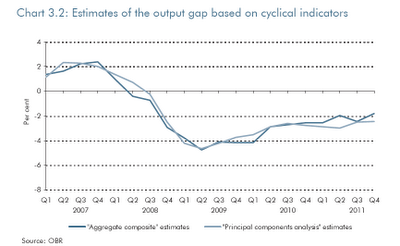
Still on the UK 2012 Budget. From the Budget ' Red book ' and the OBR report , I have found a few interesting graphs. First one is from the OBR, showing the UK output gap: Source: Office for Budget Responsibility: Economic and Fiscal Outlook , pp. 39 Is the shock that hit the UK economy in the crisis permanent or temporary? In other words, is the GDP trend line for the UK going to readjust to a lower steady state level, or is the GDP growth expected to bounce back shortly? Perhaps according to this the UK GDP is likely to return to its pre-crisis trend line, however in a much longer time span than anticipated. This only shows the size and effects of the distortion created during the crisis and the fiscal shocks (internal and external) that hit the country and reduced its productive economic capacity. Looking in the long run, any shock is temporary, even though a longer recovery will shift the medium term trend line a bit downwards. A com...

UK Budget 2012 - the analysis

The UK budget was announced today. The OBR also published its economic growth forecasts in which it revised the UK growth upwards, to 0.8% this year, and 2% the next. Available here . The initial reactions were mixed. Some policies are welcomed, some are long overdue, some are still not good enough, and some are bad. I've split them into three categories: the good ones, the bad ones and the 'limbo' - or those in between. The evaluation of the policies is based on the previous blog post on budget expectations , and whether they have meet the expectations.  Good Corporate taxes to go down even faster - to 24% immediately, and to 22% in 2014. A good policy that will benefit the British business. There is strong reason to believe it can be deemed credible. It would be better to reduce it even further all the way down to 20%, but this is a start. At least the business expectations on corporate taxes can be adjusted in the right direction.  Transparency - Tax ...

Budget expectations

Image
This week is Budget Week in the UK, so I'll focus the writings mostly around that. It's scheduled to be announced on Wednesday, but since many of the policies are already anticipated well in advance, I'll give out my own view on some of them. Many claim that this is the Chancellor's last chance to boost growth before the next election. And yet, everything seems to already be known. So let's examine this apparently crucial budget and see whether the UK will continue its Keynesian path , or will it turn to a supply-side pro-growth reform ? First off is the anticipated abolishment of the 50p tax rate . The prediction is it will go down to 45p (cautious) or even 40p (optimistic). This is long overdue. It fails to raise any significant revenue for the Treasury, it discourages high achievers, fails to attract and keep talent, discourages investors, and constrains jobs and growth. It was designed as a simple way to show that the government is determined to fight inequ...