Posts

Showing posts with the label Unemployment

Again no inflation? Velocity of money and the E-P ratio reexamined

Image
A lot of investors are wondering when exactly can we expect inflation to hit our economies? An economist's answer - only in the long run.  This bad joke is turning out to be true. Despite the huge, unprecedented (sic!) rise in money supply over the past year, it is unlikely we will experience a rapid increase in inflation over the coming two years. Why is this so?  Let's start with a fascinating development on the money markets. Velocity of money , that important indicator derived from Fisher's quantitative theory of money (MV=PQ) measuring the circulation of money in the economy (how fast goods are bought and sold), became detached from the real economy approximated by the employment-population (EP) ratio.  For those new to the blog, I have been particularly fond of tracking these two indicators, and for a very good reason - I find them a realistic portrayal of the situation in the real economy. The velocity of money has, thus far, been a great indicator of economic act...

Riding on a high: why is the market hitting records in a recession?

Image
The US National Bureau of Economic Research (NBER), the official tracker of the US business cycle, declared that the recession in the country started in February 2020 . According to NBER February was the peak of the business cycle as jobs already started disappearing (even though the huge COVID-driven unemployment claim spikes didn’t happen until mid-March ). Over the next month and a half over 42 million Americans found themselves out of work. The official unemployment rate shot up to 14.7% in April (it was 3.5% in February), and has declined back to 10.2% in July, as a more encouraging sign of a recovery driven by business re-openings. Due to the effects of COVID-19 the uncertainty in the economy is still huge, and is still the biggest it has ever been according to the Economic Policy Uncertainty Index . Almost every graph we see during the pandemic has a label “unprecedented” attached to it; we are usually looking at a very steep exponential curve facing up (for unemployment, unce...

What I've been reading (vol. 11): Atkinson & Stiglitz

Image
Atkinson, Anthony (2015) Inequality. What Can Be Done? Harvard University Press & Atkinson, Anthony (2008) The Changing Distribution of Earnings in OECD Countries. Oxford University Press The first two books, both written by the same author, Oxford economics professor Sir Tony Atkinson , will be reviewed jointly. The reason is that the earlier book, The Changing Distribution of Earnings in OECD Countries is more a case study summary of the empirical facts behind the rise of inequality in the West in the past century, the point of which is again summarized in the first few chapters of the author’s latest book Inequality . Basically the earlier book is a very detailed portrayal of the worrying inequality trend in the case of 20 OECD economies. It has two main parts – the first which depicts both the theoretical arguments and the summary of the historical trends for all the given countries, and the second which (on over 200 pages) details all the data, the graphs and the ind...

Why is the US white middle class going rouge? ... and voting for Trump

Image
A recent paper published in PNAS by Princeton professors Anne Case and Angus Deaton (last year's Nobel prize winner ) reported a stunning finding: there has been a significant increase in mortality and morbidity among middle-aged non-Hispanic white men and women in the US over the past 15 years . The causes have been attributed to suicide, and drug and alcohol abuse. The graphs below summarize the findings: Mortality in selected countries, 1990-2013. USW stands for US white. USH stands for US hispanics. Source: Case & Deaton (2015) "Rising morbidity and mortality in midlife among white non-Hispanic Americans in the 21st century." Proceedings of the National Academy of Sciences Vol. 112(49) December 8th 2015. Mortality by cause, US white non-Hispanics, 49-54. Source: Case & Deaton (2015) "Rising morbidity and mortality in midlife among white non-Hispanic Americans in the 21st century." Proceedings of the National Academy of Sciences 112(49) Dec...

Graph of the year: The Fed increases interest rates!

Image
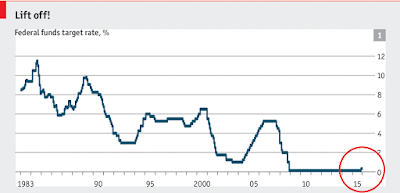
It has happened. The Fed has raised short-term interest rates for the first time since the start of the financial crisis in 2008. And immediately they've doubled it! The rate went up from 0.25% to 0.5%, with a pledge to be gradually increased further in the years to come. In Janet Yellen's own words: "This marks and end to an extraordinary seven year period."  Source:  The Economist An increase of interest rates in theory implies several things. Central banks increase interest rates when they want to curb the expansion of the economy, or in other words to prevent its overheating. A quarter of a basis point increase hardly means the US economy is overheating, but in the wake of the liquidity trap during the crisis and the recovery, and particularly Fed's  September 2012 announcement  that it will purchase mortgage securities as long as it takes until the labor market "improves", this move is viewed as a careful and gradual "return to normal...

Video: How would a Nobel prize winner run the economy?

Image
From LSE's You Tube channel : If the video doesn't work (some browsers could do that), see it here . LSE's Nobel professor Christopher Pissarides is being 'grilled' by Conor Gearty in his Gearty Grillings . The short video surprisingly includes a lot of good ideas on the size of state, labor markets, and the Eurozone troubles. Even though he declares him self an open social democrat, it's obvious he believes in the power institutions and doesn't succumb to any of the typical socialist fallacies. Nor is he being unrealistic about the solutions awaiting Europe.  Just to remind the readers, Pissarides won the Nobel prize for his search frictions theory in the labor markets. Here's the Nobel prize lecture , and you can find some of his best papers here , and the newest ones here .

Two faces of modern entrepreneurship

Image
The Atlantic had a very interesting recent text on the "Mysterious Death of Entrepreneurship in America" where they tell the tale two breads of entrepreneurs, one thriving and the other one hopelessly failing. At the same time when Silicon Valley entrepreneurs are soaring, the smartphone app market is booming, pages like Kickstarter are redefining the the very supply and demand for funding (providing a very interesting alternative to all sorts of traditional lending schemes), but on the other hand business dynamism overall is declining. Mom and Pop stores are dying out. BLS has the data:  Brookings has produced a study describing the very same process of entrepreneurial decline, where the declining business dynamism is obvious across all sectors of the economy. As I've written before, the  process of creative destruction  in the US has halted in the past years. And why is this worrisome? Because of the effect on job creation. No longer are US SMEs the key...

Graph of the week: The misery index

Image
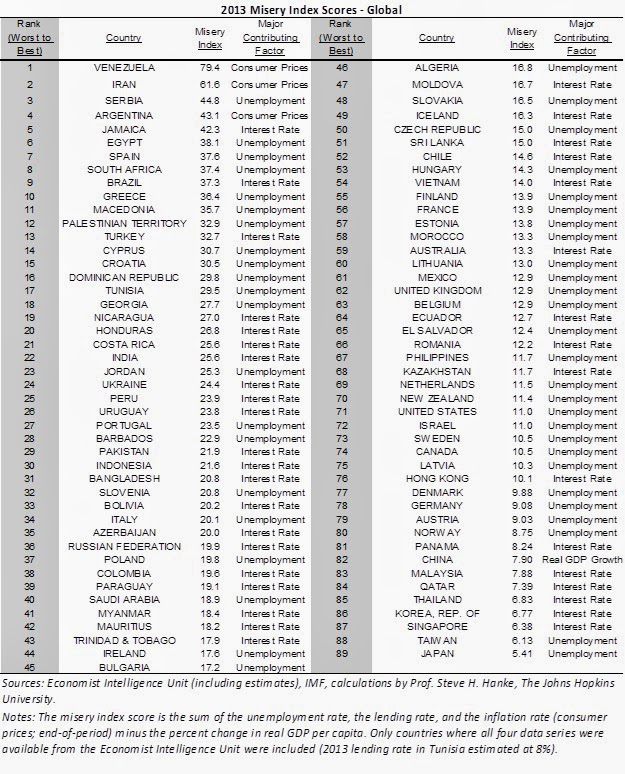
Recently I came across a new interesting index  of economic development measuring the opposite of the usual wealth, prosperity, happiness and income p/c. This one ranks countries in reverse order, it measures their relative "misery" with respect to their unemployment situation, inflation and bank lending - so all the stuff that makes people poor and hence miserable.   Steve Hanke of the Cato Institute  and John Hopkins University, used the data from the Economist Intelligence Unit ranking 89 countries. He applies a very simple methodology: sum of inflation, bank lending and unemployment rates minus year-by-year per capita GDP growth (so as to offset the temporary negative effects of the former variables). He got the intuition from Arthur Okun and Robert Barro who used things like inflation, unemployment and government bond yields to measure relative misery levels in the US during different Presidential administrations. The first apparent criticism to such an approa...

Week links (3)

Image
An overview of the best of the rest in the economic blogosphere and beyond (and some news as well). 1. The US unemployment rate is down to 6.6% ( BLS ) "Total nonfarm payroll employment rose by 113,000 in January, and the unemployment rate was little changed at 6.6 percent ... After accounting for the annual adjustment to the population controls, the civilian labor force rose by 499,000 in January, and the labor force participation rate edged up to 63.0 percent. Total employment, as measured by the household survey, increased by 616,000 over the month, and the employment-population ratio increased by 0.2 percentage point to 58.8 percent...." Yet the E-P ratio is still where it was in 2009 (even though some of the people who lost jobs in the crash got them back, others (e.g. new entries) are still reluctant to entering the market. There is also a matter of many elderly workers choosing early retirement, in addition to many old inefficient jobs being lost, while...

The real problem with minimum wages

Image
This week, the Economic Policy Institute , a liberal (left-wing) US think tank, has released an open letter to the US President Barack Obama and the leaders of Congress in which they urge the government to raise the minimum wage. In total 75 US economists have signed the letter, including Nobel laureates Joseph Stiglitz, Kenneth Arrow, Eric Maskin, Peter Diamond, Robert Solow, Michael Spence, Thomas Schelling and a number of other notable economists such as Larry Summers, Emmanuel Saez, Dani Rodrik, Daron Acemoglu, etc. These are some very respectful names in the field, and when a group such as this one signs a policy proposal, one should hear what they have to say.  Their idea is the following: an increase in the minimum wage would benefit the economy as a whole, causing not only a direct increase of wages for 17 million workers, but also spillover effects to other workers as the employers would "adjust their internal wage ladders". Consequently this would boost their p...