Posts

Showing posts with the label Monetary Policy

The bond market is showing no signs of recession. Yet.

Image
This article was first published on Seeking Alpha on July 15th 2021 . This article contains updated graphs for the subsequent month and a half (a new version will look at the situation again in October).  A lot of investors and analysts like to look at various stock market indicators for signs of widespread market hubris, overconfidence, greed (&  fear ), or an upcoming contraction. Many like to point out that stock valuations are at their extremes, particularly in the tech sector, or that, for example, the Shiller PE ratio is running at a 39 multiple (the only time it was higher was prior to the 2000 dot-com bust). Many such indicators certainly have merit for uncovering sentiment, and while they can be good indicators of whether a bubble is reaching its climax (e.g. the Shiller PE ratio), whether a market is overheating, or that a correction is due, a much better indicator of an upcoming contraction is the bond market.  This is not only true historically (e.g....

Again no inflation? Velocity of money and the E-P ratio reexamined

Image
A lot of investors are wondering when exactly can we expect inflation to hit our economies? An economist's answer - only in the long run.  This bad joke is turning out to be true. Despite the huge, unprecedented (sic!) rise in money supply over the past year, it is unlikely we will experience a rapid increase in inflation over the coming two years. Why is this so?  Let's start with a fascinating development on the money markets. Velocity of money , that important indicator derived from Fisher's quantitative theory of money (MV=PQ) measuring the circulation of money in the economy (how fast goods are bought and sold), became detached from the real economy approximated by the employment-population (EP) ratio.  For those new to the blog, I have been particularly fond of tracking these two indicators, and for a very good reason - I find them a realistic portrayal of the situation in the real economy. The velocity of money has, thus far, been a great indicator of economic act...

Monetary and fiscal bubbles after COVID

Image
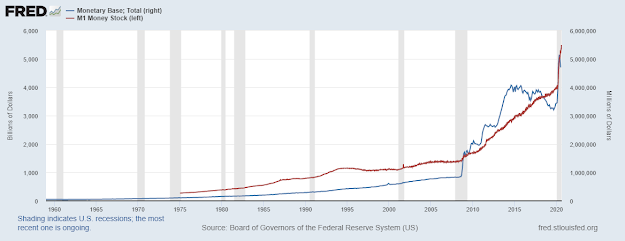
In the previous blog I analyzed the stunning divergence between the markets and the real economy. I emphasized three particular reasons for why this is happening: (1) huge monetary and fiscal stimuli that started the V-shaped rebound on the markets in March; (2) exuberant (and by all means irrational) expectations driven primarily by the so-called retail investors (the subject of one of my next blogs), and (3) the asymmetry between firms driving the market (the top 5 big tech firms) vs the unlisted SMEs laying people off and declaring bankruptcies.  In this blog I will touch upon the potential instabilities of the first effect: the monetary and fiscal stimuli.  While the stimuli were designed to calm the market panic back in March, its continuation - particularly from the Fed - is creating massive instabilities elsewhere. Specifically, there is ample evidence of a growing monetary bubble , unavoidable fiscal instabilities due to rising debts and deficits, and even a potentia...

Explaining our current stagnation

Image
Ever since the financial crisis of 2007-2009 and its subsequent (slow and modest) recovery  many have claimed the world has entered into a state of prolonged stagnation. In addition to economic growth being relatively low (and therefore not enough to close the potential GDP gap caused by the crisis), real wages are also stagnating, unemployment is still high (although in relative decline), inflation is close to zero, while productivity growth is sending troublesome signals for some time now. This is particularly true of Europe, as it bears the strongest resemblance to Japan , and is on a good course to repeat Japan's (still ongoing) two decades of stagnation (more on emulating Japan in my next text).  We all know the story. I, for one, have told it many times on the blog (see here ,  here , here , here , here , here or here ). After the financial crisis, which usually tends to cause prolonged and slow recoveries, many governments adopted stimulus and bailout program...

The Swiss are encouraged to DELAY paying their taxes!?

Image
Last week the FT brought the story that a certain Swiss canton, Zug , is asking its taxpayers to delay paying their taxes and their bills. Surely to anyone this piece of news sounds astonishing. The authorities are asking their taxpayers not to pay their taxes on time? What an atrocity! What is to make of this?  First a few words on the specifics of the Swiss tax system. The authorities of the canton are simply asking their taxpayers not to pay their taxes early . A policy of the Zug canton has been to reward early payments of tax bills by giving discounts to those who do. This means that a taxpayer can lower its tax bill by paying early. It is a great encouragement for both the authorities to maximize their fiscal capacity and tax collection, and for the taxpayers to pay their taxes (the alternative of not paying - tax evasion - carries a greater opportunity cost once you are given an incentive to lower your tax bill. The policies of tax amnesty are similar in its incentiv...

2016 predictions: Women in charge, reversal of fortunes, and Brexit?

Image
After summing up the successes and failures of my last years' predictions in the previous post, it's time to make new ones. Each year the same; I look ahead and try to anticipate the most important economic and political outcomes on a national, regional, and global scale. I tend to be quite precise ( see my track record ), but I always manage to overlook the importance of some events (like the Ukrainian crisis in my predictions for 2014 , or the refugee crisis for 2015). For the upcoming year one of the arcs will be 'Women in charge' . Why such a title? Well, primarily because by the end of next year we could have 5 out 10 most powerful political positions in the world held by women.  Angela Merkel, the EU (German) Chancellor, Christine Lagarde, Director of the IMF, and Janet Yellen, the Chairman of the Fed, could be joined by Hilary Clinton as the next President of the United States, and quite possibly Irina Bokova as the Secretary General of the United Nation...