Posts

Showing posts with the label Social Spending

What I've been reading (vol. 11): Atkinson & Stiglitz

Image
Atkinson, Anthony (2015) Inequality. What Can Be Done? Harvard University Press & Atkinson, Anthony (2008) The Changing Distribution of Earnings in OECD Countries. Oxford University Press The first two books, both written by the same author, Oxford economics professor Sir Tony Atkinson , will be reviewed jointly. The reason is that the earlier book, The Changing Distribution of Earnings in OECD Countries is more a case study summary of the empirical facts behind the rise of inequality in the West in the past century, the point of which is again summarized in the first few chapters of the author’s latest book Inequality . Basically the earlier book is a very detailed portrayal of the worrying inequality trend in the case of 20 OECD economies. It has two main parts – the first which depicts both the theoretical arguments and the summary of the historical trends for all the given countries, and the second which (on over 200 pages) details all the data, the graphs and the ind...

The day after

Image
The fiscal cliff has been averted , for now. It appears that the commitment device I was referring to in the previous text was strong enough after all. My argument was that the Nash equilibrium of the bargaining game will prevent an outcome and force the US down the cliff. I modeled it as a weak commitment device, without time discounting, and without having written down any of the parties' utility functions. Having included these parameters, the game would have given a scope for a cooperative equilibrium, however with a lower probability than a non-cooperative equilibrium. This can be extended in a lot of ways.  Anyway, I wasn't all that wrong, since the budget cuts deal was put off for two months (so no deal was reached here - the model didn't account for extending the deadline), there were no reforms to entitlement spending and there were no reforms of the complex tax code. The tax rate deal was reached , taxing only individuals earning more than $400,000 p/y (at...

Cliffhanger: The fiscal cliff bargaining game

Image
The negotiations over the fiscal cliff in the US are entering its final stages . The current situation is a stand-still, where both sides know the concessions they need to make, but neither is willing to make the first move and loose leverage. The Republicans are unwilling to make concessions on tax increases to high-income earners, while the Democrats are refusing to reign in the welfare system and finally reform it. The situation is close to a classical hawk-dove game (or even better a game of deterrence  in which neither of the two actors are willing to back off. We've heard arguments from both sides claiming that if no agreement is reached the other side is willing to “push” the US over the fiscal cliff. In particular if either of the sides is unwilling to back off from cutting spending or raising taxes , then both will have to agree to a status quo level of automatic deep spending cuts and big tax hikes. Only then will we experience the full effects of a comple...

Explaining the US "fiscal cliff"

From the Economist comes a good video on what is the fiscal cliff all about: The Wall Street Journal offered their own interactive feature called "Make your own deficit-reduction plan" . So I did. Feel free to check it out here . Please be aware that I was being politically careful when I was making this "plan". On the tax side I extended the Bush tax cuts for middle income families, and focused mostly on easing out tax deductions (here is where I agree with the Economist in pointing out to eliminate tax breaks rather than increasing the tax rates - recall an earlier text on taxes ). I've also found this part interesting: "Tax greenhouse-gas emissions by setting up a program to force polluters to buy a permit for each ton of carbon dioxide emitted into the atmosphere" . Sounds like a good Coase solution to an externalities problem, particularly if these permits could be bought and sold on the market. This, I feel, is one of the best possib...

Is there an optimal size of government?

A recent blog post by Brian Caplan reminded me of a great post by Scott Sumner from a about month ago about the issue of an optimal size of government. He compares the Scandinavian model, which to a narrow conservative mind presents somewhat of a paradox where a large size of government coexists with high levels of economic freedom, to the current US system of relatively smaller government, but decreasing economic (and personal) freedom . Brian Caplan has the story where he disagrees with Sumner’s distinction between the terms 'size of government' and 'market freedom'. Where Sumner makes an important difference, Caplan thinks market freedom cannot be achieved with a high expenditures to GDP ratio within an economy. Sumner responded to this soon enough , saying that expenditure to GDP ratios "vastly overstate the difference between the Nordic and Singaporean [for example] models. That's why I focus on variables like MTRs [marginal tax rates] and tax ...

The 47 percent

Image
The US Presidential candidate Mitt Romney held a dinner for his donors from which a hidden camera revealed a statement which was frowned upon by most of the media lately: "There are 47% of people who will vote for the President no matter what. Alright, there are 47% who are with him, who are dependent on the government, who believe that they are victims, who believe government has the responsibility to care for them, who believe they are entitled to healthcare, to food, to housing!" Read the full transcript on the NY Times , or hear the video here . Frankly, I don't know what all the fuss is about. Ok, perhaps there aren't so many Americans that are fully dependent on the government, but I can see what Mr Romney meant when he said that, by looking at either one of these two graphs :  Source: Wall Street Journal, Nicholas Eberstadt: "Are Entitlements Corrupting Us? Yes, American Character is at Stake" August 31st 2012. I however doubt th...

On budget plans

Image
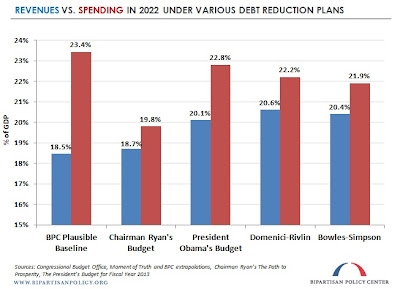
I already covered the Ryan budget proposal back in March , calling it hypocritical and in certain parts unrealistic. I praised some aspects of his taxation reform proposals, but I didn’t approve of his expenditure side reforms, particularly concerning defence spending, and have fully aligned with what Ron Paul had to say on the Ryan budget, calling it disappointing in which it continues to assume that “the federal government should [more or less] continue to do everything it is currently doing”, and that Congress should learn to “stop trying to run the world, run the economy and run our lives”. Five months later the Ryan budget is again the focal point of attention due to Paul Ryan's nomination for Vice President by Mitt Romney, the Republican challenger to President Obama in the 2012 US Presidential elections. This resulted in many economists and political commentators having once again repeated their main points from five months ago on what this budget can and cannot do. And s...

Social transfers and the welfare state

Image
The points made in the previous post  on net contributions paid and entitlements received got me thinking on the whole debate regarding transfers and their outburst during the recent crisis. As the quote from Makiw has shown, accounting for net transfers while calculating the progressiveness of the tax system paints a more precise picture of the US redistribution of income (amid all the controversies over how those numbers were calculated). Even though the number for transfers to the bottom quintile group is biased upwards, it is still nonetheless true that on average lowest quintile groups receive more from the government than what they contribute to. And this is fair in some instances where people are disabled or for other reasons unable to work (retired or children). But the escalation of transfer payments towards a rising 'army' of unemployed can have negative long-term consequences as well.  The following graph shows an e...

Two points on taxes

They’re not all that recent but can come in handy any time. The first one is on the progressivity of taxes and transfers, while the second one is on the morality of tax evasion. A well informed reader would probably guess instantly (based on the vividness of the ongoing debates) that the first one is concerning the US, while the second one is concerning the UK. And he or she would be right.  A post by Gerg Mankiw a month ago introduced a different perspective on the unfair income tax debate. It shifted the attention from low taxes on the 1% of high income earners to the high transfers received by the rest of the public. He got the numbers from a recent CBO report on the distribution of income and taxes.  "Because transfer payments are...the opposite of taxes, it makes sense to look not just at taxes paid, but at taxes paid minus transfers received. For 2009...here are taxes less transfers as a percentage of market income (income that households earned fro...