Posts

Sweden - a cherry on top

Image
The final chapter of the cross-country coverage of successful (and not so successful) recoveries ends this month with Sweden, the star of the recovery.  Sweden is often hailed by Keynesists and many alike as a "poster child" of a welfare state that succeeds in creating an equal society while maintaining macroeconomic stability. It  is very often promoted as the model upon which the US and the UK should organize their economies.   But Sweden today is far from it. It has moved from a focus on equality to a focus on dynamic growth. I t is  persistently  ranked among the   most free nations   in the world (along with other Scandinavian countries).  Particularly in the last 20 years, Sweden became the perfect example of a state with high levels of individual and economic freedom.  It has an institutional system which clearly defines rules in a society but which doesn't discourage innovation or incentives to work and create valu...

What Germany wants?

Image
Europe is once again on the edge of the cliff. They’ve been in this situation so many times since August last year that the entire story is becoming ridiculous. Spain is out of money to finance itself and its banks; Greece , even though the pro-bailout coalition was formed, remains Europe’s weakest point; Italy is in direct threat of a Spanish default (the situation was reversed 6 months ago, when Italy was the one who threatened to pull Spain along with it), and yet the blame again falls on Germany. Some economists even claim that Germany is being the biggest threat to the survival of the euro and that its forced austerity and unwillingness to step up and offer more bailouts and more support for the Union, are the main reasons behind Europe’s slow (and virtually non-existent) recovery.  Even among the Germans themselves, notable economists argue over whether or not Germany should offer more bailouts and consequentially bear more risk (I recommend an interesting debate on t...

Graphs (images) of the week: Separated by a border

Image
Usually comparing countries or regions requires looking at GDP growth data, GDP per capita, living standards, relative income or even the happiness index. But even a simple areal glimpse at the borders separating two systems can be more than enough to conclude which country is richer, healthier, more educated and on average more prosperous. It tells us that the causes of between-country differences have to be more than just climate, geography, culture or mentality. Particularly when the same nation is separated by nothing more than a border depicting the striking differences in political systems of the two countries (a classical example here are East and West Germany, but an equally good example can be North or South Korea).  As a result I found that the following set of images paint a better  picture  on between-country differences   than any existing data on global inequality.  The first one is from a  blog post I encountered on the Why Nations ...

The Baltic lessons

Image
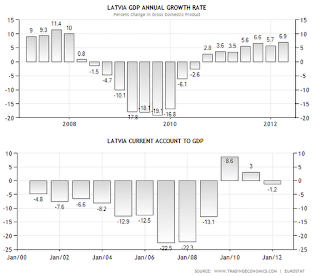
The monthly cross-country overview continues with examples from the Baltic and their lessons for Europe and its endless recovery.  Source: Trading Economics In his latest article , Olivier Blanchard, chief economist of the IMF, pinpoints the success story of Latvia, a country that experienced a typical boom-bust cycle. After a strong,  Chinese-style growth in the decade preceding the crisis followed by a sharp increase of its current account deficit (>20% of GDP - see figure), in 2008 due to mostly outside contagion came a slump and a 10% decrease of GDP (in 2009), huge fiscal deficit, capital flight and surging unemployment (from 5.4% at its 2008 bottom to 20.7% at its peak in 2010). It’s striking how similar all these European cases are – from Iceland to Spain and Ireland, which all sustained a typical asset price boom, to Greece , Italy or Portugal whose governments based their electoral winning welfare state policies on cheep borrowing conditions – they al...

What’s behind Iceland’s rapid recovery?

Image
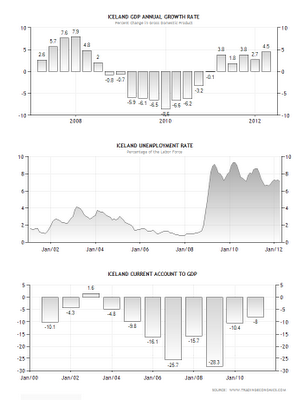
Source: Trading Economics Iceland’s crisis and recession went down much harder than in most European countries (well, except Greece ). Cheep credit and (unobserved) accumulation of systemic risk in the early 2000s led to a substantial distortion of signals sent to the real economy. They had a huge exposure to the US financial system with assets tied to many US subprime mortgage-based securities . The post-Lehman collapse followed by the subsequent bankruptcy of Iceland’s overleveraged banks was hardly a surprise. The state interfered by protecting domestic depositors, not allowing the taxpayers to take the burden of a bailout. But this didn't stop Iceland from leading  a first case of a trial against a PM for mishandling of the crisis (accused for "negligence"). Mr Haarde was later found innocent by the countries’ courts, but it was nonetheless a strong message sent from Iceland on the seriousness of what happened back in those years. The GDP fell during his prime-m...