Posts

Cliffhanger: The fiscal cliff bargaining game

Image
The negotiations over the fiscal cliff in the US are entering its final stages . The current situation is a stand-still, where both sides know the concessions they need to make, but neither is willing to make the first move and loose leverage. The Republicans are unwilling to make concessions on tax increases to high-income earners, while the Democrats are refusing to reign in the welfare system and finally reform it. The situation is close to a classical hawk-dove game (or even better a game of deterrence  in which neither of the two actors are willing to back off. We've heard arguments from both sides claiming that if no agreement is reached the other side is willing to “push” the US over the fiscal cliff. In particular if either of the sides is unwilling to back off from cutting spending or raising taxes , then both will have to agree to a status quo level of automatic deep spending cuts and big tax hikes. Only then will we experience the full effects of a comple...

Happy 2013!? (the yearly predictions)

Image
This time last year I finished off with a post summarizing briefly the predictions on the upcoming year. I was surprised to see that I was right on several predictions. Here's what I've written back then , for the US, UK and Eurozone economies:  Unemployment is still at high levels and is likely only to rise. Output on the other hand, as well as investments, are likely to fall. Stagnation is upon us. Ok, so the US has experienced stronger growth ( 3.1% in Q3 ) and falling unemployment ( 7.7 % in November ) (even though the employment-population ratio is still stagnant), but the shadow of the fiscal cliff looms over the entire 2013. For Britain and the Eurozone the prediction was spot on - the recession re-emerged in the form of a "double-dip". 2013 doesn't look that good either, even though the US could turn out to be much bette r if the fiscal cliff is avoided.  Further more, this part of the previous text summarizes not just the past year, but th...

Understanding the "growth problem"

Image
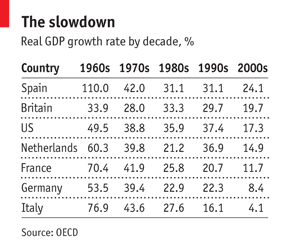
Buttonwood , a columnist in the Economist, had a recent column on the "Growth problem" in the West. He seems to hold strongly to the austerity vs. growth paradigm and claims that the issue of declining economic growth has been a problem in the West for quite some time:  Source: Buttonwood, The Economist  "But it is worth remembering that Europe's growth problems did not start in 2010. As the table shows, real growth rate in the six European countries featured above has been slower in each successive decade (on average); the drop between the 1960s and the noughties was a staggering 54 percentage points. The US, which is shown for contrast, saw fairly steady growth from the 1970s to the 1990s before dropping off this century. ... It may well be that European economies would perform better collectively if austerity programmes were relaxed. But it is a stretch to believe that Europe can return to the growth rates seen in the 1960s or even the 1970s. And t...

Explaining the US "fiscal cliff"

From the Economist comes a good video on what is the fiscal cliff all about: The Wall Street Journal offered their own interactive feature called "Make your own deficit-reduction plan" . So I did. Feel free to check it out here . Please be aware that I was being politically careful when I was making this "plan". On the tax side I extended the Bush tax cuts for middle income families, and focused mostly on easing out tax deductions (here is where I agree with the Economist in pointing out to eliminate tax breaks rather than increasing the tax rates - recall an earlier text on taxes ). I've also found this part interesting: "Tax greenhouse-gas emissions by setting up a program to force polluters to buy a permit for each ton of carbon dioxide emitted into the atmosphere" . Sounds like a good Coase solution to an externalities problem, particularly if these permits could be bought and sold on the market. This, I feel, is one of the best possib...

"The World's most important chart", courtesy of Goldman Sachs

Image
In an interview for Business Insider , the chief economist of Goldman Sachs, Jan Hatzius, predicts an acceleration of US economic growth in the second quarter of 2013. Business Insider points out that Mr Hatzius had the foresight to predict the housing boom in 2007 (so at least a year after Shiller, Roubini, Schiff and many others ), and has a unique framework for analyzing the economy. After all, he is the top economist of Goldman Sachs which is by itself worth (some sort of) admiration.  He stressed out the following chart depicting the relationship between private sector savings and government budget deficits (click to enlarge):  Source: Goldman Sachs (2012) "The US Economy in 2013-2016: Moving Over the Hump" via Business Insider Here's the logic behind it:  "The chart demonstrates a critical economic concept: Government deficits (the grey line) are essentially the mirror image of private sector savings (the dark black line). When the priv...