Posts

Showing posts with the label Adam Smith

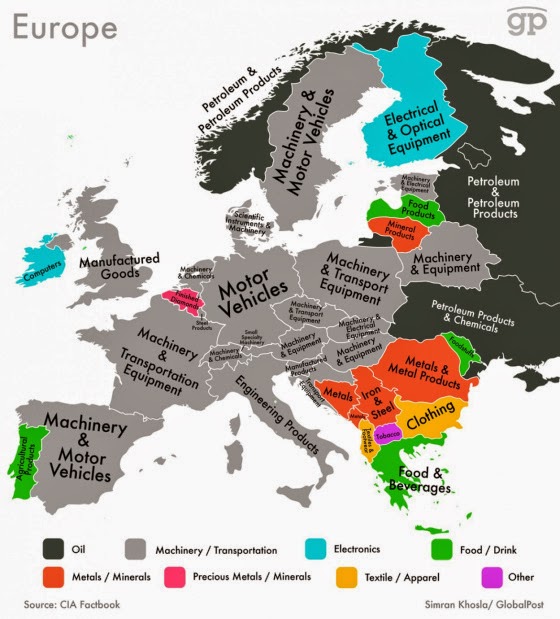
Graph(s) of the week: What is specialization?
Image
According to the classical international trade theories of Adam Smith and David Ricardo countries specialize in producing those goods and services in which they have a comparative advantage . Comparative advantage simply means that some countries can produce certain goods more efficiently (at a lower cost) than others. Be it geography, climate, or the presence of certain key resources (land, raw materials, oil, quality labor, capital), each of these may carry a potential advantage making one country relatively better than other countries at producing a particular good.  Relative is the key word here as comparative advantage doesn't imply absolute advantage. Some countries can probably produce all goods better than other countries, but this doesn't mean they have to. They can specialize in what they do best (with respect to all other countries) and leave the production of things they are relatively less good at to other countries and import it from them at a lower cost....

Economic history: mercantilism and international trade

Image
All too often during poor economic times many debunked economic fallacies of the past get reinvented. The reason is simple: a search for ideas and solutions alternative to the "mainstream" (however we define it) allows those who succumb to these fallacies to repeat the ancient errors classical economics was hoping to get rid of. The short-termism of politics plays a crucial role in the process of persistent perpetuation of such fallacies. This is why in times like these it is essential to go back in economic history and debunk some of the ideas that tend to surface repeatedly. In the following couple of posts, I attempt to do just that.  Misunderstanding trade  One of the most misunderstood areas of economics is international trade. More precisely, the idea that if we were to boost net exports - by subsidizing exports and constraining imports - we can achieve higher GDP growth. If one looks at the simple arithmetic of a standard Keynesian macro model: Y=C+I+G+NX, the...

More 'good hunches'

Image
In previous texts, I've pointed out to some more and some less precise predictions on future economic events. While Samuelson was way off on the Soviet Union's economic expansion (as are so many economists today on China ), Mankiw was pretty accurate regarding the problems of the US debts and budget deficits along with the unsustainability of the US social security model and subsidized mortgages ( this was the topic of the original 'Good hunches' post ). Other good hunches include Rajan , Roubini  (aka Dr. Doom),  Shiller  (Mr. Bubble) and a few  others  on the upcoming financial turmoil. However, good predictions are usually very hard to find. In fact the economic science is faced with much more bad predictions. Not to go too deep in history and examine the predictions on the demise of the Soviet Union and communism in general, just remember how many pundits claimed in November 2011 that the Eurozone will break up by the ne...