Posts

Showing posts with the label Banking

The corporate debt bubble: CLOs and company bankruptcies
Image
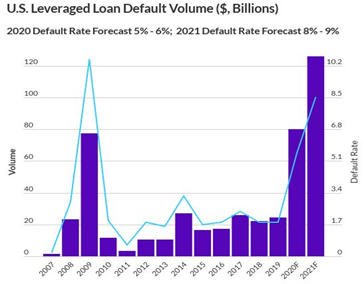
In addition to monetary and fiscal bubbles , another potential issue that could be exacerbated by a prolonged period of low interest rates are rising corporate debt levels of publicly listed nonfinancial companies. Total corporate debt of such companies has already reached historical highs by surpassing $10 trillion in Q1 2020 , and is likely to keep growing in the months to come. Adding to this another 5.5 trillion of corporate debt from SMEs and other non-listed companies the total corporate debt size in the US is now at 73% of GDP . This is still lower than household debt in 2009 which reached almost 100% of GDP, and with lower rates of growth. However, corporate debt will keep on rising – as it did during the 2009 crisis – as a necessary consequence of the pandemic and increasing risk exposure of many companies. Leveraged loan market and CLOs About $1.4 trillion of that market (also at historical highs) is comprised of leveraged loans , which include all loans securitized in someth...

The ECB stress test: same old, same old

Image
The ECB performed another stress test on Europe's biggest banks. Here is the full report and here is the brief presentation . This stress test represents a yearlong audit of Europe's largest lenders to evaluate their hidden pressures and potential problems that could arise if another recession hits them. The conclusion was that 24 EU banks (out of the 130 tested) are about 25bn euros short of the money they would need to survive another potential financial crisis (this is what a stress test does - it assumes negative economic scenarios such as sharp declines in GDP and in equity markets, or spikes in interest rates, unemployment and oil prices, and then uses a series of simulations to calculate the losses of banks in the next several years to evaluate whether or not they have enough capital to 'weather the storm'). However the ECB has stated that half of these banks which failed the test (12) have already raised enough capital to make up for the shortfall. Wha...

Taleb's antifragility and pseudostability

Nassim Nicholas Taleb , most famous for his bestselling brilliant book "The Black Swan" , published a new book last year - "Antifragile: Things That Gain from Disorder" , where he presents a rather interesting argument. I haven't read the new book yet (I intend to), but I came across two interviews he did for Financial Times presenting his argument.  His main point is on political volatility. If I were to ask you a question: "Which country is going to be better of in the future - the one characterized by more political volatility or the one with more political stability?", what would you answer? The first though that comes to mind is that stability is inherently good. But according to Taleb this need not always be the case.  If one  approaches this question through the democracy vs autocracy  debate, where democracies will always carry more political volatility than autocracies, then the argument makes much more sense. A democratic system, ...

Graph of the week: 5 years after the crisis

Image
Last two weeks on the blog, much like in the most of the mainstream media, the focus was on the 5 year "anniversary" of the financial crisis. I opened with a text on Fannie and Freddie's reemergence on the housing market, continued with an overview of some causes and implications of the crisis, and topped it up with the end consequences and cross-country effects .  So today, to finish off the "crisis coverage", I call upon a series of graphs to illustrate some of the main consequences on the financial system.  Source: The Economist The changes are evident in the world of finance. The first two charts show the emergence of Chinese state-backed banks which have managed to break up the dominance of US, UK and European banks, even as the size of top 5 banks' assets has increased (again mainly thanks to the Chinese banks). However, being fully aware of the reasons behind the rapid growth of Chinese banks , they are in for a roller coaster ride simi...

Five years after the crisis: the consequences

Image
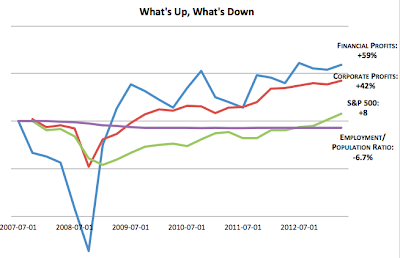
Having portrayed some of the causes and implications of the financial crisis in my previous blog post , in this one I will focus on the consequences and how the countries struck by the crisis are doing today. First off, what has really changed since five years ago? Comparison of US financial and corporate profits, S&P 500 performance and the employment-population ratio. Source: The Atlantic   The quick answer is not much. But the devil is in details. The graph above clearly states that corporate and financial profits have recovered quite significantly, while the E-P ratio remains to be dreadful. An obvious conclusion emerges. The real sector of the economy is entering a new equilibrium and the labour market is yet to adjust. The structural shock has altered the patterns of production and labour market specialization, and it's going to take time for the demand for skills to adjust. The IT shock and the outsourcing trend were among the strongest disruptions on the la...

The Chinese bubble economy: How long will it withstand the pressure?

Image
China's GDP growth slowed down to 7,5% in the second quarter of this year, mostly thanks to faltering exports and retail sales. Albeit, this is still impressive growth, despite the fact that the government will probably miss its annual growth target for this year. There is something to be worried about - it's the way in which China keeps on hitting its growth targets. Here's the WSJ : "China’s economy is far too dependent on investment –which has in recent years made up around half of all growth. Household consumption, meanwhile, was just 38% of GDP in 2011–some 20 to 25 percentage points below the consumption rates among China’s neighbors ...    China’s massive investment rate all but guarantees vast amounts of malinvestment . In other words, plenty of these resources haven’t really been invested but rather have been consumed in altogether unsatisfying ways that have made people marginally better off in the near term (keeping people in work and oligarchs ...

The Cyprus bailout

Image
This week the negotiations in Cyprus over its fragile banking system reached a new low. Cyprus was given a  € 10bn bailout (they desired  € 17bn initially) from the Eurozone to recapitalize its banking system, with the price they have to pay for this being dire. This radical bailout plan forces a 9.9% tax on deposits over  € 100,000, and 6.7% on deposits under  € 100,000. Unlike previous bailouts in Greece, Portugal or Spain where bond-holders took a big cut, this is the first time a bailout proposal will fund itself from peoples' savings. The signal this is sending is that small savers (not responsible for the crisis) should be punished while the bond-holders who willingly took risks should be protected. Needless to say such a bailout proposal is very likely to turn into a disaster for the domestic economy. Investors were spooked, the people went to the streets, mainly to  pull out their money from banks , while  markets dropped  at the sight of such...

Graph of the week: inter-bank transactions

Image
Transactions between Eurozone banks shows an interesting pattern (click to enlarge): Source: The Economist It looks like the banks are taking cash away from the PIIGS, Belgium and France, and are moving them mostly to Finland (!?), Germany and the Netherlands. The Finland issue is particularly interesting. Perhaps this has something to do with it: Moody ranked Finland's banking system the strongest in the EU.  No wonder these countries are having trouble kick-starting their economies; their banks are shrinking assets and are thus lowering the possibility for further credit and deposit creation. As an effect of high risk and uncertainty money is leaving the countries (recall the Spanish situation from June last year) and is further strangling the system. The ECB's help is also pretty useless in this case since the banks are not losing money; they are transferring it to a lower risky environment. Does "doing whatever it...

An overview of market monetarism

Image
As I briefly mentioned in my last blog post , the credit for Fed’s latest monetary stimulus is given mostly to a group of theoretical monetary economists called market monetarists. This post will recapitulate their main idea and act as a critique of some parts of their arguments. Market monetarists reject the idea that central banks have lost ‘ammunition’ to stimulate the economy. They, in fact, believe that monetary stimulus is the only thing that can help the economy at this moment. Even under the zero-lower bound (ZLB) constraint. Evidence? A rise in stocks and investor confidence after the news of QE3, QE2, QE1, and fall of Spanish and Italian bond yields after ECB actions (in August 2011, December 2011, and most recent ones in July and September 2012). However, they claim, this isn’t enough, as central banks can do much more in impacting aggregate demand.  Aggregate demand can, from a monetary perspective, be stimulated in two ways: quantitative easing (or any othe...

The LIBOR scandal

Image
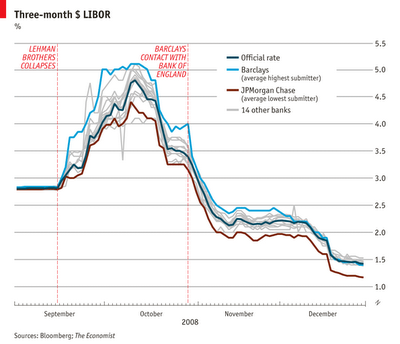
London’s financial markets have been disrupted severely in the past few weeks. The LIBOR scandal revealed a striking image of how the financial system worked and how it was interrelated with the political and the regulatory environment. The signals were being disrupted from a whole number of sources.  The LIBOR is the London Inter-Bank Offered Rate, which basically means the rate at which banks are willing to lend money to each other. It is a benchmark rate used for a number of transactions and financial instruments, ranging from mortgages to derivatives, thereby affecting the prices of loans. Its total breach on the market is an estimated $800 trillion-worth of financial instruments. The whole process of setting up the LIBOR rate is that each bank sends its own estimate of the rate to the British Bankers’ Association (BBA), an independent body which then creates the benchmark weighted rate by cutting off the top and bottom 25% of the individual submissions. It operates on a...