Posts

Showing posts with the label Ireland

Hits and misses: Evaluating last year's predictions

Image
This is becoming a sort of a post-Christmas tradition on the blog - each year in the weak after Christmas I offer a wrap up of the year by evaluating my last year's predictions . Once again, I have to say, it was a good year in terms of what I got right (I managed to even beat my own predictions from 2014 : 85% compared to last year's 75%), but there were a few events that went under my radar (the Greece situation triggered by Syriza's victory, and the refugee crisis).  The title of last year's predictions was: "2015: Back to Realpolitik and back to growth" . My main prediction was that most economies in the West would return to having steady rates of economic growth (which came true), and that debates over the economy will be overshadowed by the return of realpolitik and muscle-flexing between Russia and the West. I've also stated that "low oil prices will be the key in prompting a stronger recovery", which they were, and I managed to exclu...

Huge budget deficits are the result of bailouts

Image
Note: This text was also published as an article for the Adam Smith Institute , on 08th February 2013. For the rest of my ASI writings, click here . Among Keynesian economists there is a resilient opinion on how the current large budget deficits shouldn't be thought of as a serious problem to the economy, since they are ultimately a result of a depressed economy. Here's the main advocate of such an approach, Paul Krugman :  "It’s true that right now we have a large federal budget deficit. But that deficit is mainly the result of a depressed economy — and you’re actually supposed to run deficits in a depressed economy to help support overall demand. The deficit will come down as the economy recovers: Revenue will rise while some categories of spending, such as unemployment benefits, will fall. Indeed, that’s already happening. (And similar things are happening at the state and local levels — for example, California appears to be back in budget surplus.)" Disre...

Imported instability: examining the causes of eurozone contagion

Image
Note: this article is an update and summary of the sovereign eurozone debt crisis page . I've added a few things and broadened the analysis. In light of the expansionary austerity debate in peripheral Eurozone, the conventional solution surrounding Eurozone’s recovery has been a call for fiscal adjustment. The idea supporting austerity arises from the viewpoint of recklessness of peripheral Eurozone governments and their extensive debt accumulation and crippling welfare states. Even though a certain level of fiscal profligacy and strong accumulation of debt were apparent in peripheral Eurozone (and it is certainly the main issue holding back its recovery), this was hardly the most important reason behind a strong and severe recession that struck these countries. The focus of the article will be on the spread of financial contagion onto the peripheral Eurozone economies, namely Greece, Portugal, Ireland, Italy and Spain.  The problems that occurred for the peripheral Eurozon...

Eurozone crisis – analysis of causes and consequences (part 4)

Image
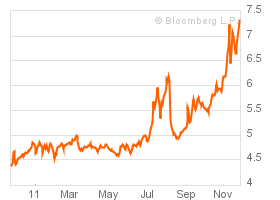
The final part of the eurozone causes and consequences analysis deals with the outcomes of the sovereign debt crisis and how it now threatens to spread contagion back to the rest of Western world and undermine the current sluggish recovery.  The summary and suggestions on the eurozone sovereign crisis and the critique of the policymakers responses were analyzed on this blog previously and can be found here and here .  What were the outcomes? Italian bond yields . Source: Bloomberg  In the last year every peripheral eurozone government was kicked out of office. Portugal and Ireland changed governments earlier in the year, Italy and Greece most recently got  technocratic governments , while Spain held elections this Sunday and saw the victory of the conservatives announcing cuts and fiscal responsibility. The political implication of the crisis was huge, and naturally the politicians needed to pay the price. Governments such as Italy’s Silv...

Eurozone crisis – analysis of causes and consequences (part 3)

Image
After the initial identification of the causes of eurozone contagion in domestic and foreign instabilities, having in mind the current debt situation we now look at how and why the banks got incorporated into the peripheral contagion, which led to further systemic risk, and finally, how did the collapse take place after a sudden credit stop. How the banks got caught up buying peripheral debt? As was already noted in this blog, eurozone banks were buying the peripheral debt as part of their zero risk-weighted assets. While the regulatory requirement on holding a corporate loan was 8%, the capital requirement for holding sovereign debt was just 1,6% (sovereign debt, considered to be a zero risk asset was given a 20% risk-weight, resulting in the total 1,6% of capital requirement for sovereign bond holdings). This meant that if a bank was to lend to sovereigns instead of businesses it could make much more money (leverage on sovereign bonds was 62.5 to one compared to leverage on busi...

Eurozone crisis – analysis of causes and consequences (part 2)

Image
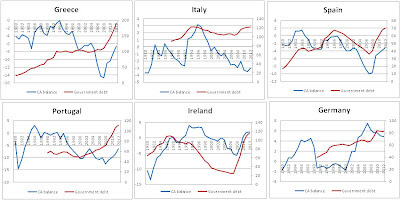
The second part observes problems inflicted to the eurozone economies from abroad. It then looks at how foreign capital inflows (due to large CA deficits shown in part 1 ) were used in domestic economies.  (Regarding the current affairs, the economist offers its own short history of the eurozone crisis , worth reading. In addition, its Free Exchange blog offers two good texts on the current eurozone affairs, one on Spain , the other on Italy .  Tyler Cowen offers an interesting summary on what we learned from the euro crisis on his blog Marginal Revolution.) Instabilities from abroad Problems with a CA deficit and the common currency When one country runs a current account deficit, this implies that it runs a surplus in its capital account. A capital account surplus means an inflow of foreign capital (investments) into a country, which is essentially a good thing since money will always flow to where it expects the highest and safest returns. However, the question i...