Posts

Showing posts with the label USA

The corporate debt bubble: CLOs and company bankruptcies
Image
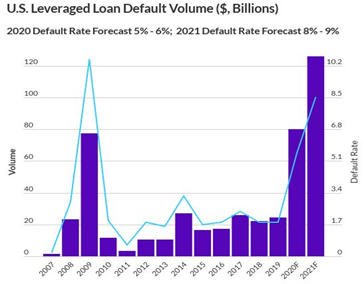
In addition to monetary and fiscal bubbles , another potential issue that could be exacerbated by a prolonged period of low interest rates are rising corporate debt levels of publicly listed nonfinancial companies. Total corporate debt of such companies has already reached historical highs by surpassing $10 trillion in Q1 2020 , and is likely to keep growing in the months to come. Adding to this another 5.5 trillion of corporate debt from SMEs and other non-listed companies the total corporate debt size in the US is now at 73% of GDP . This is still lower than household debt in 2009 which reached almost 100% of GDP, and with lower rates of growth. However, corporate debt will keep on rising – as it did during the 2009 crisis – as a necessary consequence of the pandemic and increasing risk exposure of many companies. Leveraged loan market and CLOs About $1.4 trillion of that market (also at historical highs) is comprised of leveraged loans , which include all loans securitized in someth...

Riding on a high: why is the market hitting records in a recession?

Image
The US National Bureau of Economic Research (NBER), the official tracker of the US business cycle, declared that the recession in the country started in February 2020 . According to NBER February was the peak of the business cycle as jobs already started disappearing (even though the huge COVID-driven unemployment claim spikes didn’t happen until mid-March ). Over the next month and a half over 42 million Americans found themselves out of work. The official unemployment rate shot up to 14.7% in April (it was 3.5% in February), and has declined back to 10.2% in July, as a more encouraging sign of a recovery driven by business re-openings. Due to the effects of COVID-19 the uncertainty in the economy is still huge, and is still the biggest it has ever been according to the Economic Policy Uncertainty Index . Almost every graph we see during the pandemic has a label “unprecedented” attached to it; we are usually looking at a very steep exponential curve facing up (for unemployment, unce...

This Trumpian neomercantilism is ridiculous!

Image
Protectionism never helped anyone. Particularly among the developed nations. I have yet to encounter a case of a rich country becoming even richer after imposing tariffs and trade restrictions. Even when looking at firm-level data over the long run, protectionism never helped. In many cases it arguably made them even less efficient (I provide a real-life example below). The notion that tariffs (taxes on imports) and quotas (limits on import quantities) are in general bad for the economy that imposes them could even be called a stylized fact of the profession. And it is one of those rare 'facts' a vast majority of economists would agree with; even those who like to emphasize that free trade has both winners and losers, and even those who cite the successes of South Korea or China in using state protectionism of infant industries to gain a competitive advantage abroad (although there are a  lot  more factors explaining their success - plus I have yet to see a good piece of res...

2016: a bad year for predictions

Image
Talk about Black Swans , 2016 was full of them! From elections to markets, from hacking to terrorist attacks, it was one unexpected event after another. Each a complete shocker in its own way. Especially in sports and politics.  Portugal winning the Euro  football tournament, Leicester winning the Premier League , Britain coming in second at the Olympic game medal count , or the Chicago Cubs winning the World Series  were as big as Black Swans as Brexit or Trump.  It goes without saying that a year of Black Swans was a terrible year for forecasters. Even the biggest names of the 'industry' have stumbled and failed to predict the biggest disruptive events of the year: Brexit and Trump. Not my company . We got Trump spot on . Just to remind my readers, we called 47 states including the most important swing states like PA, FL, NC, and OH for Trump. Our unique prediction method , that was further perfected since Brexit, has hit bull's-eye! Our almost perfec...

Explaining our current stagnation

Image
Ever since the financial crisis of 2007-2009 and its subsequent (slow and modest) recovery  many have claimed the world has entered into a state of prolonged stagnation. In addition to economic growth being relatively low (and therefore not enough to close the potential GDP gap caused by the crisis), real wages are also stagnating, unemployment is still high (although in relative decline), inflation is close to zero, while productivity growth is sending troublesome signals for some time now. This is particularly true of Europe, as it bears the strongest resemblance to Japan , and is on a good course to repeat Japan's (still ongoing) two decades of stagnation (more on emulating Japan in my next text).  We all know the story. I, for one, have told it many times on the blog (see here ,  here , here , here , here , here or here ). After the financial crisis, which usually tends to cause prolonged and slow recoveries, many governments adopted stimulus and bailout program...

We called it! How we predicted a Trump victory with amazing precision

Image
First of all apologies to my regular readers for not presenting our results here sooner. It's been overwhelming in the past two days - first with the prediction, then with the results, and then with the post-election frenzy.  Anyway, we gave an almost perfect prediction ! Not just a Trump victory, but also all the key swing states (PA, FL, NC, OH), and even that Hillary could get more votes but lose the electoral college vote. Here are our results as I presented them in a Facebook post on the eve of the election: For a more detailed explanation read our blog . The method is described there in greater detail, plus we call all the states. The story got covered first by the academic sources. My own University of Oxford published it as part of their main election coverage , as did my alma mater, LSE on their EUROPP blog . More news coverage soon to come! Details of our prediction  The results nevertheless came as an absolute shock to many, but it was...

New Scientist: "As US election looms, time is ripe for a new science of polling"

Image
My article got published today at the New Scientist ! One of the biggest science magazines in the world. See the text here ( there is no paywall, you just register and read it for free ). It was even on the front page: New Scientist website front page 03 Nov 2106 The text is about the scientific experiment behind our prediction survey . It starts by examining why the pollsters are getting it wrong lately and whether or not there is any science at all behind polling. Then it introduces our prediction survey idea and how we're doing an experiment on US elections to see whether or not science can actually improve polling.  For those who don't bother to register in order to read it on the New Scientist webpage, I have copied the text here (enjoy!): As US election looms, time is ripe for a new science of polling "Growing scepticism about traditional methods for predicting election outcomes is fuelling a search for a more scientific approach to polling, says Vuk ...