Posts

Graph(s) of the week: comparing US Presidential performance

Image
Relating to a graph of the week from two weeks ago, I again turn to the Economist and its interactive feature comparing the performance of  past elected Presidents  in their failed or successful re-election bids. What is really interesting is that President Obama seems to, on average, have much worse economic results than most other Presidents who failed to be re-elected, particularly in the disposable income category (third graph). The other two categories (GDP and unemployment) also look disturbing, where Obama's current performance is worse than an average failed re-election bid. Having all this in mind, it's interesting to see how a lot of economists still think he's the right man for the job (at least according to the partially biased survey described in an earlier post ). It is true that the President found himself in the middle of a huge wealth shock to the public and is facing massive develeraging (see second graph ) for the whole economy. Ther...

Is there an optimal size of government?

A recent blog post by Brian Caplan reminded me of a great post by Scott Sumner from a about month ago about the issue of an optimal size of government. He compares the Scandinavian model, which to a narrow conservative mind presents somewhat of a paradox where a large size of government coexists with high levels of economic freedom, to the current US system of relatively smaller government, but decreasing economic (and personal) freedom . Brian Caplan has the story where he disagrees with Sumner’s distinction between the terms 'size of government' and 'market freedom'. Where Sumner makes an important difference, Caplan thinks market freedom cannot be achieved with a high expenditures to GDP ratio within an economy. Sumner responded to this soon enough , saying that expenditure to GDP ratios "vastly overstate the difference between the Nordic and Singaporean [for example] models. That's why I focus on variables like MTRs [marginal tax rates] and tax ...

Graph of the week: Eurozone nominal wages

Image
FT Alphaville has got a new graph from Credit Suisse: Source: FT Alphaville ; HT: Tyler Cowen Observe the changes in nominal wages in the pre-crisis decade (grey columns). It reminds me of a graph I've had before in the text on Sweden , where unit labour costs were compared across the Eurozone periphery to Sweden and USA, with respect to German labour costs. The effect on competitiveness was more than clear from that graph. This one shows a similar convergence picture, where Greek, Irish and Spanish nominal wages were adjusting to equate the Eurozone 'average' (there was another similar graph which measured real disposable income  for various EU economies).   Germany, on the other hand, in the same period experienced a significant nominal wage decrease partially as an effect of the unification in the 1990s, but mostly because of their labour market reforms which have ensured a long period of wage moderation. As I've shown in a previous text , t...

"Unburdening enterprise"

Image
Today, the Adam Smith Institute published my paper on the deregulation of UK small and medium-sized businesses (SMEs), entitled " Unburdening Enterprise. Reducing regulation for small & medium businesses ".  The paper received coverage in the Financial Times , The Times  (both require subscription access), Conservative Home , Politics (where in both, ASI's policy director Sam Bowman wrote good pieces outlining the main proposals of the report), and many others.  Here is a blog post I wrote for the ASI to sum up the report. I will quote it in full:  "Regulatory confinements very often result in wrong policy perceptions and adverse policy conclusions. In an attempt to create a safer environment they impose a number of rules, procedures, and amendments to these rules that eventually end up stifling companies and diverting their resources away from productive activities. This is particularly endangering for small and medium-sized businesses (SMEs), ...

Confirmation bias

Image
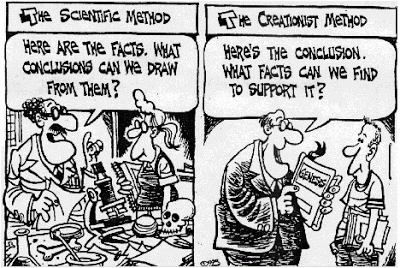
From Wikipedia : "Confirmation bias is a tendency of people to favor information that confirms their beliefs or hypotheses. People display this bias when they gather or remember information selectively, or when they interpret it in a biased way. The effect is stronger for emotionally charged issues and for deeply entrenched beliefs. For example, in reading about gun control, people usually prefer sources that affirm their existing attitudes. They also tend to interpret ambiguous evidence as supporting their existing position." Source In other words when one person thinks his or her opinions are based on years of rational and objective analysis, but in reality they are the result of years of exposure to information that only confirmed his or her prior beliefs, while any information that was challenging the predetermined opinion was being ignored and/or rejected.  Why am I referring to this psychological phenomenon? Because I'm starting to enjoy reading behav...